Introduction
There is no single credit score required for every business loan. Requirements shift by lender, product, loan amount, and whether the lender looks at personal credit, business credit, or both.
That matters when payroll is due, inventory needs restocking, or customers are paying invoices 60 days late. A federal survey found that 60% of online-lender borrowers reported higher-than-expected borrowing costs, according to the Federal Reserve's 2026 report, so knowing what you're walking into pays off.
This guide compares score expectations by product and lender, covers what else underwriters weigh, outlines options for low or limited credit, and shows how to prepare.
Key Takeaways
- No universal minimum exists; published thresholds range from none to 700+.
- Lenders also weigh revenue, time in business, cash flow, debt, and collateral.
- Low credit doesn't close every door, but costs and risks rise.
- Check both credit profiles, size your request, and compare offers before applying.
What Credit Score Do You Need for a Business Loan?
Minimum score versus competitive score
A minimum score is the cutoff to apply. The score needed for the best rates, larger amounts, or unsecured financing is often higher. OnDeck publishes a 625 personal FICO minimum, but restricts its lowest rates to exceptionally strong credit and cash flow.
Treat any figure as a lender-specific example, not a market rule.
Personal credit versus business credit
Lenders often check the owner's personal credit when the business is new, a sole proprietorship, or lacking business credit history. A personal guarantee can also be required.
According to myFICO guidance, young businesses commonly rely on the owner's personal profile. A guarantee may still be needed even without a personal credit check.
Established businesses can lean on their own record. Business scores measure different things:
- D&B PAYDEX: 1-100, based on payment history
- Experian Intelliscore Plus: 1-100, where 76-100 is low risk
- FICO SBSS: 0-300 scale
Why scores affect approval and terms
Scores help lenders estimate repayment risk. Weaker scores can mean:
- Denial or higher pricing
- Smaller amounts or shorter terms
- Added collateral or a personal guarantee
Stronger scores can open cheaper, longer, and unsecured options.
Interpreting your score
The score in your monitoring app may not be the one a lender pulls. Lenders choose their own models, and FICO versions weight data differently. FICO 670+ often counts as "good," but that's an educational label, not an approval line.
How Credit Score Requirements Vary by Loan Type and Lender
Requirements by financing product
These are published examples, current as of 2026, not market averages.
| Product / lender | Published requirements | Notes |
|---|---|---|
| Bank term loan (Bank of America) | Personal FICO typically above 700; 2 years in business; $100,000 revenue | Unsecured; $10,000+; 12-60 months |
| SBA 7(a) | Creditworthy, repayment reasonably assured | Up to $5M; 7(a) Small up to $350,000 |
| SBA microloan | Set by nonprofit intermediary | Up to $50,000; interest generally 8%-13% |
| Line of credit (American Express) | 660 FICO; 1 year; $3,000 monthly revenue | $2,000-$250,000 |
| Short-term online (OnDeck) | 625 FICO; 1 year; $100,000 revenue | 6-24 months; daily/weekly payments; average APR 53.2% on term loans |
| Equipment (Bank of America) | 2 years; $250,000 revenue; no score published | From $25,000; secured by the asset |
| Invoice factoring | Customer credit and invoice value often matter most | Seller may stay liable under recourse factoring |
| PayPal Working Capital | No personal credit check; based on PayPal sales | Fixed fee; percentage-of-sales repayment |
| Commercial real estate | Property cash flow, debt service, collateral | No universal score minimum |

Requirements by lender type
Banks and credit unions emphasize repayment capacity, history, and collateral. Navy Federal frames this as the Five Cs of business credit. Online lenders trade speed for cost.
Nonprofit CDFIs aren't automatically easier. Accion Opportunity Fund, for example, publishes these thresholds:
- 660+ credit score
- 2 years in business
- $300,000 in prior-year revenue
Criteria differ even within one loan type, so confirm current underwriting before a formal application.
SBA loans and credit scoring
The SBA sets program standards, and participating lenders add their own. Under federal lending criteria, borrowers must be creditworthy with repayment reasonably assured. SBA ended SBSS screening for 7(a) Small applications on March 1, 2026, so older SBSS cutoffs are outdated. Owners of 20% or more must give an unlimited personal guarantee.
Loan size and credit score
Score doesn't set the amount. Revenue, cash flow, existing debt, time in business, collateral, and the product's ceiling do. Two businesses with a 700 score can get very different offers if one has stronger deposits and less debt.
What Else Do Lenders Consider Besides Credit Score?
Revenue, cash flow, and repayment capacity
Lenders review bank statements, revenue consistency, profit and loss statements, and projections. For 7(a) Small loans, SBA requires a debt service coverage ratio of at least 1.10:1 and review of two months of operating-account activity. That's an SBA benchmark, not an industry-wide one.
Uneven cash flow is common:
- Staffing firms fund payroll before invoices are paid
- Medical practices wait on insurance reimbursements; in one 2024 AMA poll, 55% of respondents used personal funds during a claims disruption
- Retailers borrow for summer inventory and repay in holiday sales
- Contractors front materials while waiting on project draws
Time in business and stability
Operating history, consistent deposits, and recurring customers help when credit is imperfect. Newer businesses lean harder on personal credit, a business plan, collateral, or projections. Published minimums run from 3 months to 2 years depending on the lender.
Existing debt and the requested amount
Loans, card balances, liens, tax obligations, and other monthly payments all reduce repayment capacity. Calculate what you actually need and show how the money produces revenue, buys a productive asset, or closes a defined gap.
Collateral and personal guarantees
Secured loans pledge assets such as equipment, vehicles, real estate, inventory, or receivables. Unsecured loans skip that pledge, but they often still require a personal guarantee or lien. Before signing, understand what you could lose, including personal assets.

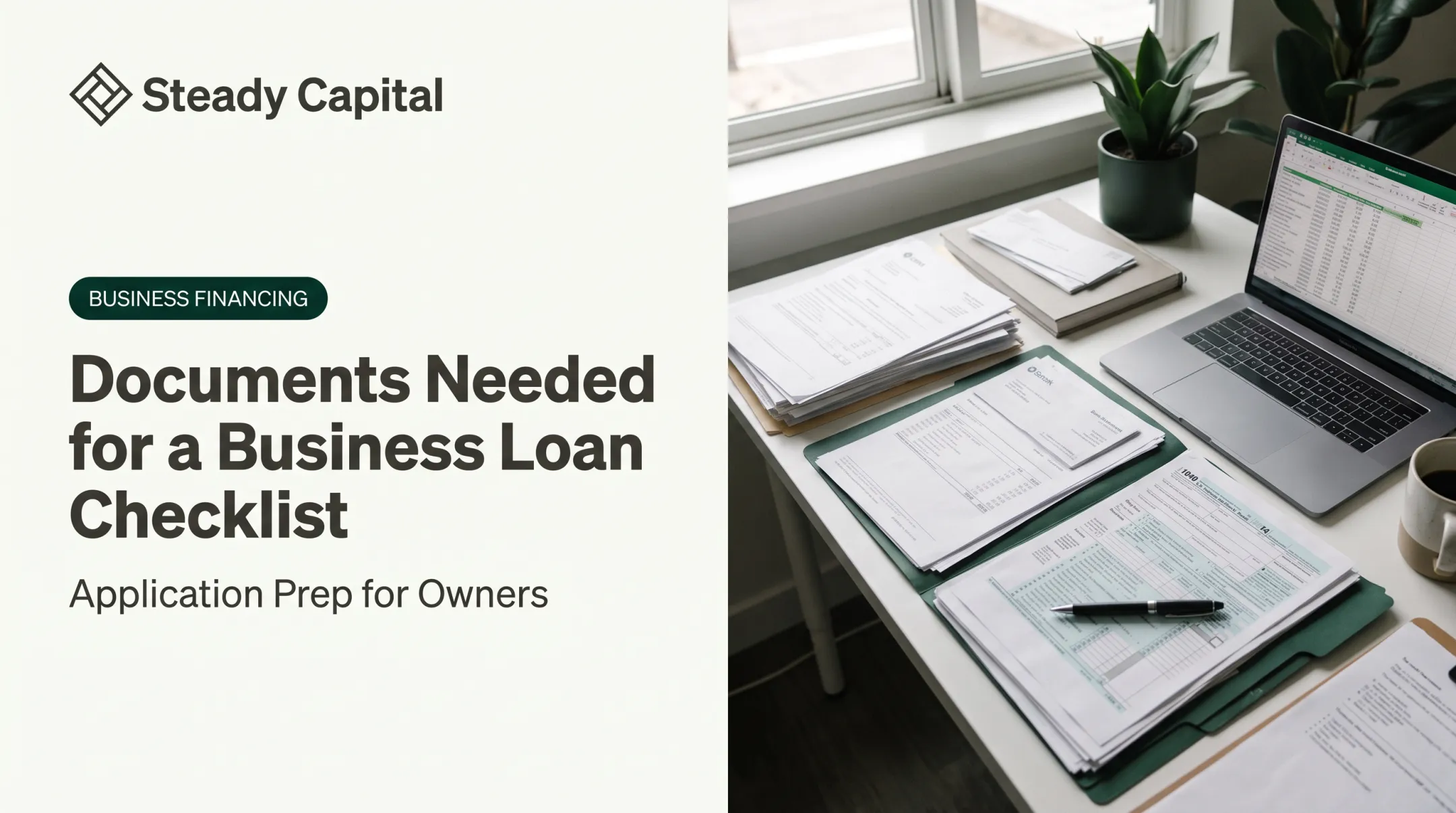
Documentation
Expect to provide:
- Formation and ownership records
- Tax returns and bank statements
- Financial statements and debt schedules
- Accounts-receivable reports
- Licenses and, where relevant, a business plan
A clear use of funds helps the lender match you to the right product.
Can You Get Business Funding With Low or No Credit?
Yes. You can still get business funding with low or no credit when underwriting focuses on revenue, invoices, deposits, or collateral instead of score alone.
Options that weigh other factors
- Invoice factoring: your customers' credit and invoice quality matter more than yours
- Revenue-based products: processor sales and deposits drive eligibility; PayPal requires an account 90+ days old and at least $15,000 in annual PayPal sales
- Microloans and secured loans: intermediaries set terms, and capacity and history still count
- Lines of credit: some providers weigh revenue and cash flow heavily
"No credit check" never means "no underwriting." Lenders still review revenue, invoices, deposits, time in business, and identity.
Costs and risks
Lower-credit financing can bring higher costs, shorter terms, frequent payments, smaller limits, collateral, or guarantees. The Federal Reserve notes that factor rates differ from APR and confuse borrowers.
Compare:
- APR where available, plus total repayment
- Origination and administrative fees
- Prepayment terms
- Automatic withdrawals and default provisions
- UCC filing or collateral language
Disclosure rules vary by state. California and New York require APR on covered offers, while Virginia and Utah don't.
Steady Capital Solutions as one resource
Steady Capital Solutions is a financing marketplace that connects businesses with third-party providers for working capital, lines of credit, invoice factoring, revenue-based advances, and growth financing. The company says no specific personal or business credit score is required, and it lists funding from $30,000 to $5,000,000.
It also states eligibility of at least 3 months in business and proof of cash flow, with collateral optional. It is not for startups.
Funding depends on independent provider underwriting. Pricing, fees, and repayment vary by applicant, provider, product, and state, and a personal guarantee or UCC filing may be required. Verify current eligibility, pricing, documentation, and terms before applying. Approval is never guaranteed.

How to Prepare Before Applying for a Business Loan
Review credit and fix errors
Pull your personal reports free weekly at AnnualCreditReport.com. Look for wrong late payments, duplicates, identity problems, liens, and judgments. Under CFPB guidance, disputes are generally investigated within 30 days.
Avoid unnecessary new applications. Prequalification and your own report checks are typically soft inquiries, while formal applications may trigger a hard inquiry.
Build a lender-ready profile
Write a one-page funding summary:
- Requested amount and exact use of proceeds
- Repayment source
- Expected business benefit
- Current obligations
- Realistic cash-flow projections
Then gather supporting documents:
- Bank statements and tax filings
- Financial statements and receivables reports
- Ownership records and collateral details
Compare offers before accepting
Look past the headline amount and speed. Compare:
- Total cost, APR, or factor rate
- Payment frequency and fees
- Prepayment terms, collateral, and guarantees
- Default terms and funding timeline
Apply only with lenders whose requirements fit your business, and ask about any unclear term before signing.
Frequently Asked Questions
What credit score do I need to get a business loan?
There's no universal minimum. Some sales-based products skip a minimum score entirely, while certain bank loans look for scores above 700. Lenders may check personal credit, business credit, or both.
Can I get an SBA loan with a 500 credit score?
No public SBA standard lists 500 as a qualifying score. SBA requires creditworthiness and reasonably assured repayment, and participating lenders set their own criteria.
How long does it take to build a credit score from 500 to 700?
It varies. Experian says rebuilding can take a few months to a few years, depending on the cause of the low score, payment history, utilization, and errors.
How big of a business loan can I get with a 700 credit score?
Score isn't the only factor. Revenue, cash flow, debts, time in business, collateral, loan purpose, and lender limits all shape the amount.
Can I get a $100,000 SBA loan?
It's within the 7(a) Small ceiling of $350,000 but above the $50,000 microloan cap. Approval depends on lender underwriting, repayment capacity, credit, and documentation.
What qualifies for a commercial loan?
Lenders look at credit, revenue, time in business, cash flow, collateral, business purpose, and legal documents. Requirements are product- and lender-specific.